

Home Renovation Savings Program: What Ontario Homeowners Claim
The home renovation savings program pays Ontario homeowners rebates for efficiency upgrades. See which upgrades qualify, what to do first and what to avoid.
The Home Renovation Savings program is an Ontario rebate program that pays homeowners for energy efficiency upgrades such as insulation, heat pumps, windows and doors, solar panels and efficient appliances. You must own the home, and for the insulation, window and air sealing rebates you need an energy assessment before any work starts.
We read the program's own pages on November 19, 2026, and this guide puts the rules in the order you need them. If your upgrades are part of a bigger plan, our whole home renovation team can sequence the efficiency work with the rest of the job. Amounts and rules change, so confirm each one on the program website before you commit.
What is the Home Renovation Savings program?
It is a rebate program delivered by the Independent Electricity System Operator's Save on Energy brand together with a natural gas utility, with support from the Government of Ontario. It has two streams: one for bundled upgrades that starts with a home energy assessment, and one for single upgrades that does not.
The program page states that the amounts shown are maximums and that terms and conditions apply to specific rebates. We leave the dollar amounts out of this guide on purpose, because they change and the program page is the only place to read the current ones.
| Stream | Upgrades | Do you need an assessment first? |
|---|---|---|
| Bundled upgrades | Attic, foundation, exposed floor and exterior wall insulation; windows and doors; heat pump water heaters; air sealing | Yes, before any work, and at least two upgrades |
| Single upgrades | Cold climate air source or ground source heat pumps; solar panels with optional battery storage; attic insulation; smart thermostats; appliances | No |
Which upgrades need an energy assessment first?
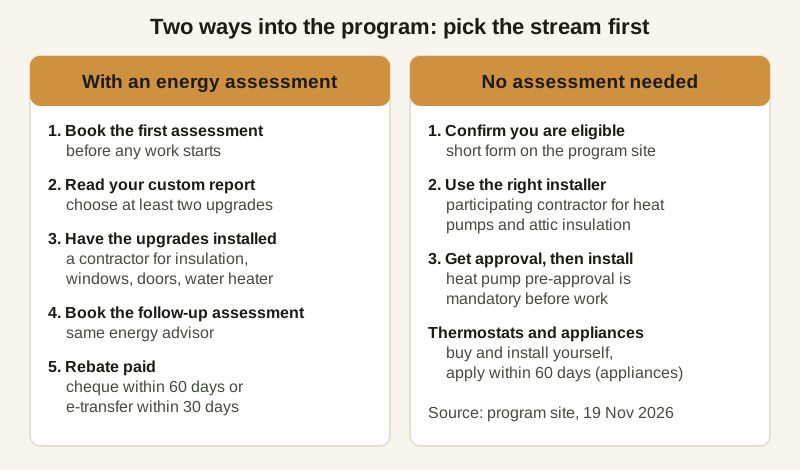
Insulation (attic, wall, foundation and exposed floor), windows and doors, heat pump water heaters and air sealing need a home energy assessment before any work begins, and you must complete at least two of them to qualify. The program's help page says an initial assessment takes about two hours and a follow-up assessment takes about one hour.
A registered energy advisor assesses the home from basement to attic and gives it an EnerGuide rating and a report. You choose at least two upgrades from the report, have your contractor install them, then book a follow-up assessment with the same advisor. The program says completing three qualifying upgrades earns an extra bonus rebate for follow-up assessments dated on or after January 5, 2026, and that your assessment costs are partly offset by a rebate after you finish.
The help page names the contractor rule plainly: you must hire a professional contractor for new windows, a heat pump water heater or added insulation, while air sealing can be done yourself if the home meets the minimum air change target. It recommends leaving air sealing as your third upgrade or later, because the result decides whether it counts.
What counts as one upgrade?
The program counts each building area once, so a big window order is still one upgrade. This matters because the two-upgrade minimum is where bundled projects fail.
- Attic and cathedral ceiling: counted together as one upgrade.
- Basement wall, crawl space wall and foundation header: counted together as one upgrade, and a foundation header alone does not count.
- Windows and doors, including skylights and sliding doors: all together count as one upgrade.
- Exterior wall, exposed floor, crawl space ceiling, basement slab, heat pump water heater and air sealing: one each.
If you are already opening a wall for another reason, this is where planning pays off. A basement project that exposes the foundation wall, such as a basement renovation, is a natural time to insulate it. Order the assessment before the work, not after.
Which upgrades can you claim without an assessment?
Heat pumps, solar panels with optional battery storage, attic insulation, smart thermostats and appliances can be claimed without an assessment. For heat pumps the program says pre-approval is mandatory and installations done before approval are not eligible for rebates.
The rules differ by upgrade:
- Heat pumps: use a participating contractor who submits your pre-installation application. A cold climate air source unit must be on Natural Resources Canada's qualified products list, and the rebate depends on your current primary heating fuel and the size of the unit.
- Attic insulation: use a participating contractor. To qualify, 100 per cent of the roof assembly area must be insulated, and attic insulation must reach R-50 for the attic rebate.
- Solar panels: you choose your own contractor, because the program has no qualified list for solar.
- Smart thermostats and appliances: you can buy and install these yourself.
What are the rebates available for new appliances in Ontario?
The program covers six appliance types, and each must be on its list of ENERGY STAR Most Efficient products: heat pump clothes dryers, washing machines, induction cooktops and ranges, dishwashers, fridges and freezers. You must be connected to the Ontario electricity grid, replace an existing electric appliance and buy new, since used or refurbished appliances do not qualify.
The program says to apply within 60 days of purchase and upload the receipt. The program also asks you to recycle or properly dispose of the old appliance. This applies to a kitchen update too: if you are planning a kitchen renovation, check the qualified list before you order appliances, because the model number decides eligibility.
Is your home eligible?
You must own the home, and it must be a single detached, semi-detached, row or townhome, or a mobile home on a permanent foundation. New builds do not qualify for heat pump and attic insulation rebates: the program defines them as homes occupied for six months or less.
| Check | What the program says |
|---|---|
| Ownership | You must own the home; where an owner has tenants, the owner applies |
| Home type | Detached, semi-detached, row or townhome, or mobile home on a permanent foundation |
| Heating | Natural gas from the participating utility, or the Ontario grid with electricity, propane, oil or wood |
| New homes | Not eligible for heat pump or attic insulation rebates if occupied six months or less |
| Several properties | You may take part for each property you own |
What should you do before you start work?
Closing a wall, installing new windows or blowing in insulation before the first assessment can disqualify the bundled rebates, because the program's help page says an initial assessment must be done before installation and answers "No" when asked if upgrades already started are eligible. The mistake is easy to avoid with a call to an energy advisor before the contractor books a date.
- Decide whether your plan is bundled (insulation, windows, air sealing) or single (heat pump, solar, attic).
- For a bundle, book the initial assessment first and wait for the report.
- For a heat pump, get the participating contractor's pre-approval first.
- Keep receipts, model numbers and assessment dates together.
- Check how you will be paid: the program lists cheque within 60 days or e-transfer within 30 days for the assessment stream.
Be careful with scams. The program says it does not solicit residential customers by phone or door to door, and that anyone who claims to represent it that way should be treated with caution. Use the program's help and support page to confirm what is real.
Can you claim home renovations on your taxes in Ontario?
Not as a general rule. A federal tax credit covers specific renovations, and the Canada Revenue Agency's Multigenerational Home Renovation Tax Credit page says the renovation must create a self-contained secondary unit with a private entrance, kitchen, bathroom facilities and sleeping area. The unit must be for a qualifying individual aged 65 or older, or 18 or older and eligible for the disability tax credit, and it must meet local secondary-unit rules.
The page also says only one qualifying renovation is allowed per qualifying individual in their lifetime. If you are weighing that kind of project, our guides on legal basement requirements in Ontario and in-law suites cover the building side, and our aging-in-place renovation checklist lists the funding programs for accessibility work.
How do the rebates fit into a larger renovation?
Efficiency upgrades are cheapest to do while walls, ceilings and mechanical systems are already open, so the program works best when you plan it with a renovation instead of after it. The two rules that decide this are the assessment before the work and the pre-approval before the heat pump.
- Older home: start with the assessment, because the report shows where heat is lost. Our older home renovation guide explains what is behind the walls.
- Exterior update: windows, doors and wall insulation are best planned together, so our exterior renovation page is the place to start.
Planning a project that includes any of these upgrades? Send us the address, the age of the home and which upgrades you want through our contact page, and we will respond with a written quote for the renovation. We describe what the program publishes and do not administer it, so questions about eligibility belong with the program itself.
Frequently asked questions
Who can claim the Home Renovation Savings program in Ontario?
You must own the home, and it must be a single detached, semi-detached, row or townhome, or a mobile home on a permanent foundation. It must also be heated by natural gas from a participating utility, or be connected to the Ontario electricity grid and heated with electricity, propane, oil or wood. Where an owner has tenants, the owner applies.
Can I start the work before I apply?
Not for the stream that bundles upgrades. The program says an initial home energy assessment is required before any installation starts, and work done earlier is not eligible for those bundled rebates. Heat pumps also need pre-approval before installation.
What are the rebates available for new appliances in Ontario?
The program offers rebates on eligible ENERGY STAR Most Efficient appliances: heat pump clothes dryers, washing machines, induction cooktops and ranges, dishwashers, fridges and freezers. You must replace an existing electric appliance with a new one, and you must submit your receipt within 60 days of purchase.
What grants are available for home improvements in Canada?
Federal Canada Greener Homes loans are closed: the program's help page says the last day to apply for the loan was October 1, 2025. The Ontario program described here is the main current rebate, and municipalities and other agencies run separate programs. Check each program's own page for its current status before you plan around it.
Can I claim home renovations on my taxes in Ontario?
Some renovations can earn a federal tax credit, but not general upgrades. For example, the Multigenerational Home Renovation Tax Credit applies to creating a self-contained secondary unit for a qualifying senior or an adult eligible for the disability tax credit. Ask a tax professional before you rely on a credit.
Can I combine these rebates with other programs?
The program's help page says you can take part even if you used earlier gas utility or Save on Energy efficiency programs, provided the upgrades are different from ones you were already paid for. It also says federal loan funding and these rebates can be used together.
Book a consultation for your project
Tell us about the space, the scope, and your timeline. Our design team reviews it and replies with the next step.